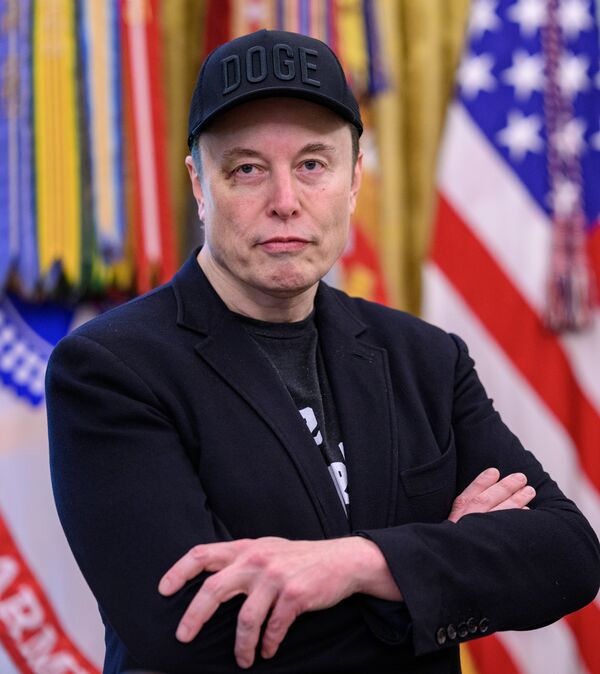
On November 12, 2024, President-elect Trump said Musk and Vivek Ramaswamy would lead a "Department of Government Efficiency" from outside the government. It was never a cabinet department. On January 20, 2025, an executive order renamed an existing technology office, the U.S. Digital Service, the U.S. DOGE Service, placed it in the Executive Office of the President, and told every agency head to set up a DOGE team of at least four employees. The order does not name Musk. Ramaswamy left the same day.
Who ran DOGE
What DOGE was, and what the White House, the president and judges have said about Musk's place in it.
The White House said on February 3, 2025 that Musk was a "special government employee," a temporary status limited to 130 days. A White House official told Reuters he was not receiving a government paycheck. In a sworn statement, DOGE's administrator later gave his dates: he became a senior adviser to the president on January 20, 2025 and left that role on May 28, 2025. The Justice Department counted 128 days.
On February 17, 2025, a White House official told a federal court under oath that Musk was not an employee of the U.S. DOGE Service, was not its administrator, and had no "actual or formal authority to make government decisions himself." Two days later President Trump told an audience in Miami: "I signed an order creating the Department of Government Efficiency and put a man named Elon Musk in charge." On March 4 he told Congress that DOGE was "headed by Elon Musk."
The White House did not say who DOGE's administrator was until February 25, 2025, when it identified Amy Gleason as its acting leader. The day before, a government lawyer had told a judge he did not know who held the job. Gleason later swore that she had held it since February 18. A federal judge wrote in March 2025: "The government has provided no information about the identity of the Administrator before Gleason."
Two federal judges in Washington addressed the contradiction in early rulings. Judge Christopher Cooper wrote on March 10, 2025 that the public statements of Musk and the president "indicate that USDS is in fact exercising substantial independent authority." USDS is the U.S. DOGE Service. Judge Tanya Chutkan wrote on May 27, 2025: "Defendants unsuccessfully attempt to minimize Musk's role, framing him as a mere advisor without any formal authority." Both rulings came early in their cases. Neither is a final finding about who ran DOGE.
Status: Both cases are still open. See the last two facts on this page.
Promised savings and the record
What Musk said DOGE would save, what DOGE claimed, and what auditors and budget figures show.
Asked at a Trump rally on October 27, 2024 how much could be cut from the federal budget, Musk said: "Well, I think we can do at least $2 trillion, yeah." On January 8, 2025 he said: "I think if we try for $2 trillion, we've got a good shot at getting 1." On March 27 he told Fox News: "Our goal is to reduce the deficit by a trillion dollars." At a Cabinet meeting on April 10 he said: "We anticipate savings in FY 26 from reduction of waste and fraud by $150 billion."
DOGE listed its claimed savings on a website it called the "Wall of Receipts." The largest item on the first list was an $8 billion saving from one contract. The New York Times found that the contract was for $8 million. DOGE answered that it had "always used the correct $8M in its calculations." CBS News found that DOGE had claimed the same $655 million saving three times. Within days DOGE had deleted all five of the largest savings on its original list, the Times reported. The Associated Press found that more than a third of the contract cancellations, 417 in all, were expected to save nothing, according to DOGE's own data.
The Government Accountability Office, Congress's auditor, examined the $110 billion in savings that DOGE itemized for contracts, grants and leases, out of the $215 billion it claimed in all. It reported that "some savings estimates are incorrect or lack supporting evidence." Of the 264 leases listed as terminated, 108 were already being terminated before DOGE existed. DOGE reported more than $1.7 billion in savings on a military health contract that was never changed: "no savings were achieved." Almost 2,000 contracts listed as terminated had not been terminated. For grants, DOGE gave too little information to verify the method behind 96% of the savings it reported. In the contracts it examined closely, GAO identified $77.8 million in potential savings. DOGE did not respond to GAO's requests.
Federal spending did not fall. Outlays were $6.7 trillion in fiscal 2024, $7.0 trillion in fiscal 2025 and $7.4 trillion in fiscal 2026, according to the Treasury. The deficit was $1.82 trillion, then $1.78 trillion, then $1.99 trillion. The Congressional Budget Office said the greatest increases in 2026 were in the largest mandatory spending programs, interest on the debt and the military. In March 2025 Musk had said DOGE could bring spending down from about $7 trillion to $6 trillion. The totals do not show what spending would have been without DOGE.
In June 2025 the White House asked Congress to cancel spending on programs DOGE had targeted. Congress passed a package cancelling about $1.1 billion for public broadcasting and nearly $8 billion for foreign aid, and President Trump signed it on July 24, 2025. The Associated Press noted that the request equaled about 0.1% of that year's federal spending.
On February 11, 2025 Musk said a "cursory examination of Social Security" had found "people in there that are 150 years old." Days later he posted: "Having tens of millions of people marked in Social Security as 'ALIVE' when they are definitely dead is a HUGE problem." The Associated Press reported that the administration was "falsely claiming that tens of millions of dead people over 100 years old are receiving Social Security payments." The agency's acting commissioner said the people in those records "are not necessarily receiving benefits." FactCheck.org found that Musk was right that millions of dead people were still listed as alive, and that about 98% of them were receiving no payments. On March 30 he said that "40% of the calls into Social Security were fraudulent." The New York Times called that misleading and wrote that he "appears to have misunderstood a statistic" from the agency. He also called Social Security "the biggest Ponzi scheme of all time," which PolitiFact rated False.
When the White House said in January 2025 that $50 million was about to be spent on condoms for Gaza, Musk reposted the claim with the words "Tip of iceberg." CNN found that USAID had provided no condoms to the Middle East in the three years of records available (see the USAID page). Asked about it in the Oval Office on February 11, Musk said: "Some of the things that I say will be incorrect and should be corrected. So nobody can bat 1,000." He then posted the exchange with the caption "$50M of condoms is a LOT of condoms." The next night he posted that Reuters "was paid millions of dollars by the US government" for "large scale social deception." CNN reported that the contract went to Thomson Reuters Special Services to work on defenses against cyberattacks that use "social deception" tactics, and that it began under Trump in 2018.
The federal workforce
The resignation offers, firings and layoffs were carried out by the Office of Personnel Management and agency heads. Each fact says what the sources tie to Musk.
On January 28, 2025 the Office of Personnel Management emailed federal employees an offer: resign now and keep pay and benefits until September 30. Its subject line, "A Fork in the Road," was the one Musk had used on an email to Twitter's employees in November 2022, ABC News reported. Reuters reported that week that the group then running the personnel office included a former Musk employee as its chief of staff. A federal judge declined to block the offer, without ruling on whether it was lawful. Agencies later reported that roughly 144,000 employees had been approved to resign under such offers.
On February 22, 2025 Musk posted that all federal employees would receive an email "requesting to understand what they got done last week," and added: "Failure to respond will be taken as a resignation." The personnel office sent the email without the threat. Two days later it told agencies that answering was voluntary and that not answering would not be treated as a resignation. It ended the weekly emails on August 5, 2025.
In February 2025 agencies fired probationary employees, most of them recent hires, in bulk. Agency court filings counted 24,813. On September 12, 2025, U.S. District Judge William Alsup ruled that the Office of Personnel Management's directive to fire them "was unlawful" and that the office had told agencies to fire under a false pretense. At a hearing in March he had said: "It is a sad day when our government would fire some good employee and say it was based on performance when they know good and well that is a lie." He did not order the workers reinstated, and told agencies to correct their records to show that they were not fired for poor performance. Earlier orders to reinstate them had been paused by the Supreme Court and overturned by an appeals court, on the ground that the groups and states that sued had no standing. The ruling is against the personnel office. It does not mention Musk or DOGE.
Some firings were reversed within days. Up to 350 employees of the National Nuclear Security Administration, which works on the country's nuclear weapons, were laid off on February 13, 2025, three officials told the Associated Press. The Energy Department said fewer than 50 were let go. By the next night the agency had rescinded the firings of all but 28. That weekend the Agriculture Department sent termination notices to several employees working on bird flu, then said it was working to rescind them.
About 10,000 employees were laid off from the Department of Health and Human Services on April 1, 2025, in a restructuring that CBS News described as designed by Secretary Robert F. Kennedy Jr. and DOGE. Two days later Kennedy said: "Personnel that should not have been cut, were cut. We're reinstating them. And that was always the plan." He described the approach: "we're going to do 80% cuts, but 20% of those are going to have to be reinstated, because we'll make mistakes." In June more than 460 laid-off employees of the Centers for Disease Control and Prevention were told they were being reinstated, their union said. In August the National Weather Service, down 560 employees, received permission to fill 450 positions.
Twenty-two major federal agencies had nearly 256,000 fewer employees in January 2026 than in December 2024, a drop of more than 11%, the Government Accountability Office found. Nearly 378,000 employees left those agencies during 2025 and about 127,000 were hired. The count covers every departure for any reason, including ordinary retirements.
Source
GAO
The Government Accountability Office estimated that agencies spent $9.5 billion in 2025 on salaries for employees on paid administrative leave, six times the 2023 figure, and that about $6.7 billion of it went to people in the resignation program, who were paid while not working. GAO cautioned that limits in the agencies' data "could overstate the actual amount used." The personnel office's director, Scott Kupor, answered that the $9.5 billion was a one-time expense and that the smaller workforce saves $40 billion a year.
The Internal Revenue Service lost about 30% of its workforce in a year. The Treasury's inspector general for tax administration reported that 31,273 employees left between January 2025 and January 2026. The Yale Budget Lab estimated that the layoffs have likely cost $597.8 billion in federal revenue over the ten years from 2026 to 2035. That is a model's projection, measured against what would otherwise have been collected. Total federal receipts rose in fiscal 2025 and again in fiscal 2026.
Government data
DOGE teams were given access to systems that hold Americans' personal and financial records. Judges disagreed about whether that was lawful, and the government won several of the cases.
David Lebryk, a senior career official at the Treasury, announced his retirement on January 31, 2025. The Washington Post reported that he had a dispute with Musk's allies over access to the system the government uses to pay out trillions of dollars a year. Treasury then gave a DOGE team access to its payment systems, and a group of states sued. On February 21, 2025, U.S. District Judge Jeannette Vargas blocked the access in a preliminary ruling, citing "the rushed and ad hoc process that has been employed to date by the Treasury DOGE Team." She noted that one team member, Marko Elez, had been given permission to change a payment database, not just read it, by mistake. In May 2025 she allowed access again under vetting and training conditions.
Status: The judge dismissed the case on September 23, 2026 as moot, because the order creating DOGE had expired and the Treasury team had been disbanded. No court made a final ruling on whether the access was lawful.
Marko Elez, one of two DOGE appointees with access to the Treasury's payment system, resigned on February 6, 2025 after The Wall Street Journal reported on posts from a social media account connected to him. The account had posted "Normalize Indian hate" and "Just for the record, I was racist before it was cool," NPR reported. The next day Musk said he would bring him back, writing: "To err is human, to forgive divine."
On March 20, 2025, U.S. District Judge Ellen Hollander blocked DOGE's access to Social Security records, writing: "The DOGE Team is essentially engaged in a fishing expedition at SSA, in search of a fraud epidemic, based on little more than suspicion." On June 6, 2025 the Supreme Court set her order aside while the case continued and let the agency give its DOGE team access. The three liberal justices dissented. On April 10, 2026 the full appeals court threw out the injunction and sent the case back to her. In the same opinion it called admissions the government had made that January "alarming" (see the next fact).
Status: The case is back before the trial judge. No court has made a final ruling on whether the access was lawful.
In August 2025 the Social Security Administration's chief data officer, Charles Borges, filed a whistleblower complaint. It accused the agency's chief information officer, whom NBC News described as a longtime ally of Musk, of breaking agency policy to "create a live copy of the country's Social Security information in a cloud environment that circumvents oversight." The agency said it knew of no compromise of the data. On January 16, 2026 the Justice Department told the court that members of the agency's DOGE team had shared data through an outside server that was not approved for it, that the agency "has not been able to determine exactly what data were shared," and that one team member had signed a "Voter Data Agreement" with an advocacy group whose stated aim was "to find evidence of voter fraud and to overturn election results in certain States." In March 2026 the agency's inspector general said it was reviewing a complaint about "potential misuse of SSA data by a former DOGE employee."
Status: The lawsuit is still open. The agency says it "has not yet seen evidence" that its data reached the advocacy group. The filings describe DOGE staff at the agency, not Musk.
U.S. District Judge Denise Cote ruled that the Office of Personnel Management's decision to give DOGE staff broad access to its records holding federal employees' personal information "without a demonstrated need was unlawful." Musk is a named defendant in the case, but the ruling is against the personnel office. The judge found that no DOGE staff member had had that access since September 2025.
Status: What the court will order as a remedy has not been decided.
The government won another case about data. A federal appeals court panel ruled 2 to 1 that a Maryland judge had been wrong to block DOGE staff from personal records at the Education Department, the Treasury and the Office of Personnel Management. It held that the trial court "abused its discretion" in finding that the challengers were likely to win.
Source
Appeals court opinion
Conflicts of interest
Musk's companies are regulated, investigated or paid by agencies that DOGE entered or that lost staff and leaders. What is documented is the overlap. The White House denies that he used his role for gain.
The White House left it to Musk and the president to manage his conflicts of interest. Reuters reported that his status let him "potentially avoid disclosure rules about conflicts of interest and finances that apply to regular government employees." President Trump said on February 3, 2025: "If there's a conflict, then we won't let him get near it." Musk said: "I'll recuse myself if it is a conflict." NBC News reported in March 2025 that there was no evidence he had obtained a conflict of interest waiver. When the Government Accountability Office asked in 2026 for the ethics training records and financial disclosures of DOGE personnel, the Executive Office of the President did not respond.
A memo by Democratic staff of a Senate investigations subcommittee found that when Musk joined the government in January 2025, he and his companies "were subject to at least 65 actual or potential actions by 11 different federal agencies." The staff estimated at least $2.37 billion in potential liability from the 40 actions it could put a price on. That is the staff's estimate of what he and his companies faced on the day he entered government, not a count of penalties avoided. The White House called any claim that Musk used his role for personal or financial gain "completely false and defamatory."
The Associated Press reported on February 24, 2025 that Musk's team was "eliminating jobs at the vehicle safety agency that oversees Tesla and has launched investigations into deadly crashes involving his company's cars." The agency said it would still "enforce the law on all manufacturers of motor vehicles and equipment." In March the Los Angeles Times listed a dozen agencies with oversight of Musk's businesses whose senior political appointees President Trump had fired or replaced.
On April 4, 2025, while Musk was a White House employee, the Space Force awarded launch contracts with anticipated values of $5.9 billion for SpaceX, $5.4 billion for United Launch Services and $2.4 billion for Blue Origin. The New York Times reported in March 2025 that Starlink, SpaceX's satellite internet service, was "now accessible across the White House campus." White House officials said that Starlink had donated the service and that the gift had been vetted by the lawyer overseeing ethics issues in the White House Counsel's Office.
How it ended
Musk left the government in May 2025. DOGE's temporary organization expired on July 4, 2026. Two cases about its powers are still in court.
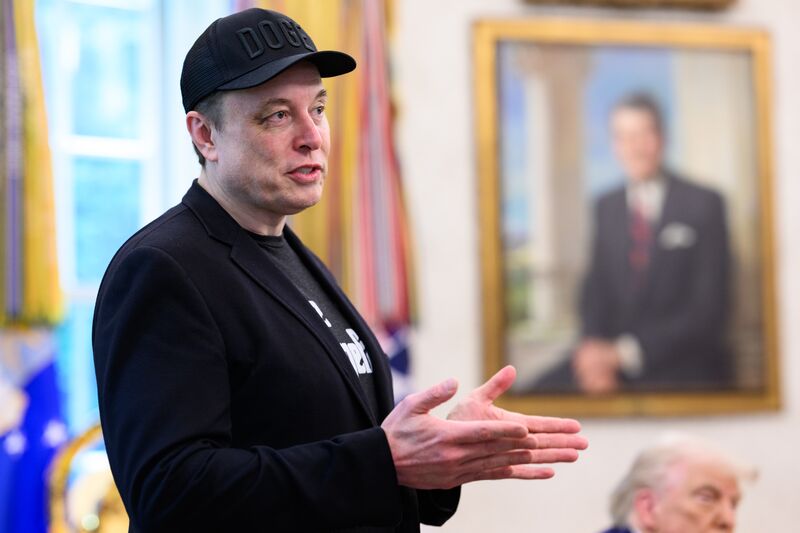
Musk posted on May 28, 2025 that his "scheduled time as a Special Government Employee" was coming to an end. Two days later President Trump held a farewell for him in the Oval Office and gave him a ceremonial key. "I think the DOGE team is doing an incredible job," Musk said.
On June 5, 2025, as Musk attacked the president's tax and spending bill, Trump said: "I'm very disappointed in Elon. I've helped Elon a lot." Musk posted: "Without me, Trump would have lost the election," and then, "Such ingratitude." Trump wrote that the easiest way to save money was "to terminate Elon's Governmental Subsidies and Contracts." Musk then claimed, without offering evidence, that Trump was "in the Epstein files." He later deleted that post, and on June 11 he wrote: "I regret some of my posts about President @realDonaldTrump last week. They went too far." The two have since reconciled, the Associated Press reported in October 2026.
In November 2025 the director of the Office of Personnel Management told Reuters of DOGE: "That doesn't exist." The DOGE Service answered that the order creating it "is still in effect." That order set DOGE's temporary organization to end on July 4, 2026. On that day DOGE's account posted: "While the formal mission of DOGE has come to an end, the mission to eliminate waste, fraud, and abuse will continue." The budget director told a House subcommittee there were no current plans to provide anything official on its accomplishments. Two weeks later The Washington Post counted nearly two dozen people hired or vetted through DOGE who remained in government.
Asked in September 2025 what he had learned from running DOGE, Musk said: "The government is basically unfixable." In a podcast released that December he said: "We were a little bit successful. We were somewhat successful." Asked whether he would do it all over again, he said: "I don't think so." In October 2026 his biographer Walter Isaacson told him he had "seemed to get a bit too intoxicated by it in a way with the chainsaws and all that." Musk answered: "Yeah, I think that's true. Yeah. Yeah. I got carried away basically."
A group of states sued in February 2025, claiming that Musk was exercising the powers of a senior federal officer without a proper appointment, in violation of the Constitution's Appointments Clause. Judge Chutkan refused to dismiss the claim in May 2025, writing of the states' allegations: "These allegations do not describe a mere advisor." The states dropped their case in December 2025, citing "events subsequent to its filing." Nonprofit groups are pursuing the same claim. On March 23, 2026 the judge let it go forward and rejected the government's argument that Musk's departure had ended it. She wrote that the claim "may continue to run against whoever has replaced Musk as head of DOGE."
Status: Pending. Fact-finding is due to end on December 18, 2026. No court has ruled on whether Musk's role violated the Constitution.
Whether DOGE must answer public records requests is undecided. Citizens for Responsibility and Ethics in Washington, a watchdog group, sued for DOGE's records in February 2025. Judge Cooper found in March 2025 that the DOGE Service was "likely covered by FOIA," the Freedom of Information Act, and wrote that its operations "have been marked by unusual secrecy." The government argues that DOGE is a presidential advisory body and exempt.
Status: The Supreme Court agreed on October 13, 2026 to hear the government's appeal. Reuters reported that a ruling is expected by the end of June 2027.