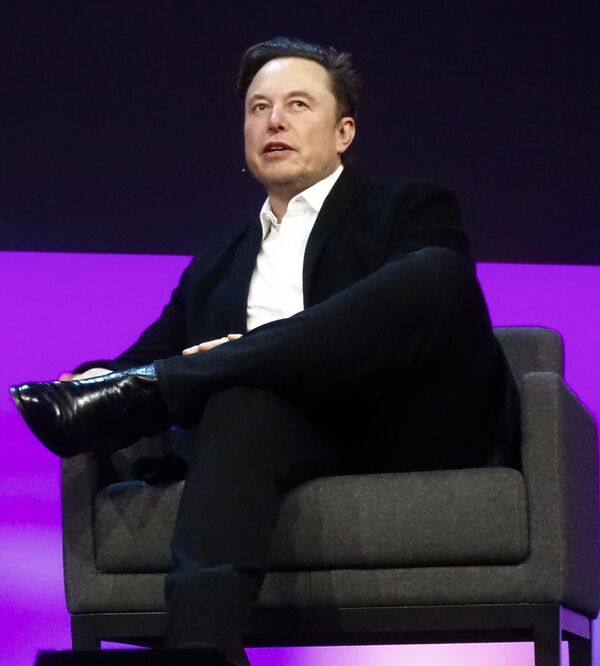
On April 14, 2022, the day he made his offer for Twitter, Musk said at the TED conference: "I think it's very important for there to be an inclusive arena for free speech." He added: "I don't care about the economics at all." A week later he posted: "If our twitter bid succeeds, we will defeat the spam bots or die trying!" On April 25, when the deal was announced, he wrote: "I hope that even my worst critics remain on Twitter, because that is what free speech means." The next day he posted: "I am against censorship that goes far beyond the law. If people want less free speech, they will ask government to pass laws to that effect."
The purchase
Why Musk said he was buying Twitter, how the deal went, and what a jury and a regulator later decided about it.
Musk offered $54.20 a share for Twitter, about $44 billion, on April 14, 2022, and the company accepted on April 25. On July 8 he told regulators he was terminating the deal. Twitter sued in Delaware to make him complete it, saying he believed he "is free to change his mind, trash the company, disrupt its operations, destroy stockholder value," and walk away. A judge granted Twitter a fast trial. On October 4, before it began, Musk said he would go through with the purchase at the original price. The deal closed on October 27, 2022. That evening he posted "the bird is freed," and the chief executive and other top executives were fired. No court ruled on the merits.
On May 13, 2022, while under contract to buy Twitter, Musk posted: "Twitter deal temporarily on hold pending details supporting calculation that spam/fake accounts do indeed represent less than 5% of users." Investors who sold their shares in the months that followed sued him. On March 20, 2026 a federal jury in San Francisco found him liable over that tweet and a second one. It rejected the claim that he ran a scheme to push the share price down, and a claim about a remark he made on a podcast. On July 6, 2026 the trial judge upheld the verdict on the "on hold" tweet and threw out liability for the second. He wrote that "the deal was not on hold," and: "This is a case about a breach of trust by Elon Musk."
Status: Musk appealed on July 30, 2026. The amount he owes has not been set. This is a civil case, not a criminal one.
Musk disclosed that he owned more than 9% of Twitter on April 4, 2022. The Securities and Exchange Commission sued him in January 2025, alleging that the disclosure came 11 days late and that the delay let him underpay by at least $150 million for shares he bought in the meantime. In February 2026 the judge refused to dismiss the case. On May 4, 2026 the two sides filed a settlement: a trust in Musk's name pays a $1.5 million penalty without admitting the allegations, and the SEC drops its claim against Musk himself. The judge approved it on July 8, 2026, writing that the court "has significant misgivings about the settlement" and that the penalty "is around 1% of the total amount of money that was potentially at stake in this case." Musk's lawyer said he "has now been cleared of all issues related to the late filing of forms in the Twitter acquisition."
About $13 billion of the purchase price was borrowed from banks, and the debt belongs to the company, not to Musk. Bloomberg reported that X's interest bill was more than $1.3 billion a year by the end of 2024. The banks could not sell the loans for more than two years. The Wall Street Journal reported that by the summer of 2024 the deal "was considered the worst buyout banks had agreed to finance since the 2008 financial crisis." They sold the last of the debt in April 2025. Twitter took in $4.5 billion from advertising in 2021, its last full year as a public company, and lost $221 million that year. In July 2023 Musk wrote that the company still had negative cash flow "due to ~50% drop in advertising revenue plus heavy debt load." One investor, Fidelity, had marked its stake down 78.7% by August 2024. In March 2025 Musk put X's value at $33 billion when he merged it into another of his companies.
The company and its workers
What Musk did inside Twitter in the months after he bought it, and what followed with employees and advertisers.
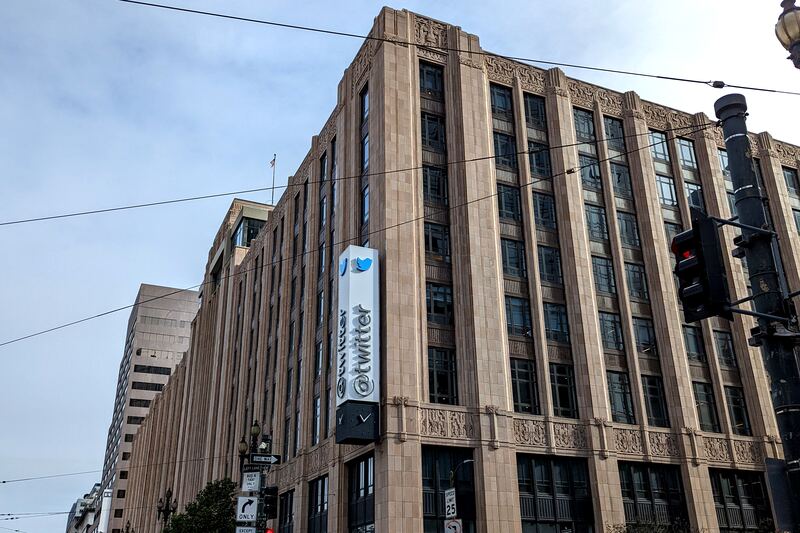
On November 4, 2022, a week after the purchase, Twitter laid off about half its staff. Musk wrote that day: "unfortunately there is no choice when the company is losing over $4M/day." In April 2023 he told the BBC that he had cut the workforce from just under 8,000 to about 1,500. The company later told an Australian regulator that by May 2023 its trust and safety staff had fallen from 4,062 to 2,849, and its engineers working on trust and safety from 279 to 55.
On November 16, 2022 Musk emailed the remaining staff under the subject line "A Fork in the Road." It read: "Going forward, to build a breakthrough Twitter 2.0 and succeed in an increasingly competitive world, we will need to be extremely hardcore." Employees had until 5pm the next day to click "yes" or leave with three months of severance. In August 2024 Ireland's Workplace Relations Commission ordered the company to pay a senior employee in Dublin, Gary Rooney, 550,131 euros for unfair dismissal, a record award there. The company had argued that he resigned voluntarily. The adjudicator found that he was dismissed because he did not click "yes," "and for that reason alone."
On November 14, 2022 a Twitter engineer publicly corrected a post by Musk about the company's Android app. After an exchange Musk tweeted: "He's fired." The next day, after the news site Platformer reported that 20 engineers who had criticized him internally were fired, he posted: "I would like to apologize for firing these geniuses. Their immense talent will no doubt be of great use elsewhere." In March 2023 an employee who has muscular dystrophy and uses a wheelchair, Haraldur Thorleifsson, asked Musk on Twitter whether he still had a job. Musk wrote that the "reason he confronted me in public was to get a big payout." The next day he posted: "I would like to apologize to Halli for my misunderstanding of his situation."
Four former Twitter executives, including chief executive Parag Agrawal, sued Musk and X for about $128 million in severance they said they were owed. Musk and X denied wrongdoing and said the four were fired over their performance. The case was settled in 2025 on terms that have not been made public. Earlier, in October 2023, a Delaware judge had ordered X to pay $1.1 million of Agrawal's legal fees. Former employees also sued for at least $500 million in severance. A judge dismissed that case in July 2024, and in August 2025, with an appeal pending, the two sides reported a tentative settlement whose terms were not disclosed.
The day before the purchase closed, Musk told advertisers he did not want Twitter to become a "free-for-all hellscape." Eight days later he wrote: "Twitter has had a massive drop in revenue, due to activist groups pressuring advertisers." In November 2023, after his reply to a post about Jewish communities (below) and a report by the group Media Matters that ads had appeared beside pro-Nazi posts, IBM, Apple, Disney and other companies stopped advertising. Asked about it at a New York Times conference on November 29, 2023, Musk said: "I hope they stop. Don't advertise." He went on: "If somebody is going to try to blackmail me with advertising, blackmail me with money, go fuck yourself." He also said: "What this advertising boycott is going to do is, it is going to kill the company."
On August 6, 2024 X sued a trade group of advertisers and several companies, alleging that they had organized an illegal boycott of the platform. Musk posted: "now it is war." The companies denied wrongdoing. On March 26, 2026 a federal judge in Texas dismissed the case against all of them, writing: "The very nature of the alleged conspiracy does not state an antitrust claim, and the court therefore has no qualm dismissing with prejudice." In July 2026 X and the trade group said they had settled the litigation.
Twitter was renamed X in July 2023. On March 28, 2025 Musk announced that his artificial intelligence company had bought it: "@xAI has acquired @X in an all-stock transaction. The combination values xAI at $80 billion and X at $33 billion ($45B less $12B debt)." On February 2, 2026 he said that SpaceX had acquired xAI. SpaceX sold shares to the public in June 2026 at a valuation of $1.77 trillion, and X is now part of it.
Speech: promises and practice
What Musk said he would do about speech on Twitter, set beside what he and the company did, with his explanations.
On October 28, 2022, the day after he took control, Musk posted: "Comedy is now legal on Twitter." He also wrote: "Twitter will be forming a content moderation council with widely diverse viewpoints. No major content decisions or account reinstatements will happen before that council convenes." On November 19 he restored Donald Trump's account after a poll on his own account, in which the "yes" vote won with 51.8%. CBS News reported that the account "was restored without any input from such a council." Musk wrote that activist groups had agreed not to starve Twitter of advertising if he formed the council, and added: "They broke the deal." Days later, after another poll, he announced an amnesty for suspended accounts.
In November 2022, asked on Twitter to reinstate the conspiracy theorist Alex Jones, Musk answered "no" and wrote: "I have no mercy for anyone who would use the deaths of children for gain, politics or fame." Jones had been banned in 2018, and relatives of people killed in a school shooting he had called a hoax had won nearly $1.5 billion in judgments against him. On December 10, 2023 Musk restored the account after a poll. Replying to a user who argued that permanent bans are contrary to free speech, he wrote: "I find it hard to disagree with this point."
On November 6, 2022 Musk posted: "My commitment to free speech extends even to not banning the account following my plane, even though that is a direct personal safety risk." On December 14 Twitter suspended that account, @ElonJet, and the personal account of the student who ran it. Musk wrote: "Any account doxxing real-time location info of anyone will be suspended, as it is a physical safety violation." He alleged that the account had been used by a stalker to follow a car carrying one of his children. The next night Twitter suspended several reporters who had tweeted or written about him. Musk wrote: "Same doxxing rules apply to 'journalists' as to everyone else." He restored the accounts after a poll. NPR reported that the United Nations and the European Union were among those that condemned the suspensions.
On December 18, 2022 Twitter announced that it would "no longer allow free promotion of specific social media platforms," among them Facebook and Instagram. The rule was withdrawn within a day. "My apologies. Won't happen again," Musk wrote. In April 2023 Twitter restricted posts that linked to the newsletter company Substack, and labeled NPR "state-affiliated media," which NPR said was the term it used for propaganda outlets in Russia, China and other autocratic countries. NPR stopped posting. Musk tweeted: "Defund @NPR." Twitter dropped the labels later that month. In August 2023 The Washington Post found that X was making users wait about five seconds when they clicked links to Facebook, Instagram, Bluesky, Substack, Reuters and The New York Times. X began reversing the delays hours after the story appeared. Musk and X did not respond to the Post.
Before buying Twitter, Musk wrote: "I am against censorship that goes far beyond the law." Under his ownership the company complied with more government orders to remove content. The news site Rest of World counted the company's own reports to a public database: in his first six months it received 971 requests from governments and courts and fully complied with 808 of them, refusing none, where the rate of full compliance had been about 50% the year before. On May 13, 2023, the day before Turkey's election, Twitter restricted some posts there. When a writer criticized the decision, Musk replied: "Did your brain fall out of your head, Yglesias? The choice is have Twitter throttled in its entirety or limit access to some tweets." Asked about posts blocked in India, he said: "If we have a choice of either our people go to prison or we comply with the laws, we will comply with the laws." X has also fought some orders in court. It sued India's government in 2025 over its takedown system; a judge dismissed the case that September, and X appealed.
In December 2022 Musk gave a group of writers access to internal company records, which they published as the "Twitter Files." He posted that Twitter "acting under orders from the government to suppress free speech, with no judicial review," would violate the First Amendment. The author of the first installment wrote in it that he had seen no evidence "of any government involvement in the laptop story," the decision the installment was about. In June 2023, when Donald Trump cited the files in his lawsuit over his ban, Twitter's own lawyers told a federal court: "None of the FBI's communications with Twitter cited by Plaintiffs evince coercion because they do not contain a specific government demand to remove content." In February 2025, while Musk was working in the Trump White House, X agreed to pay about $10 million to settle that lawsuit.
On November 1, 2022 Musk announced that the blue check mark, which had meant that Twitter had confirmed who was behind a notable account, would be sold: "Power to the people! Blue for $8/month." Days after the launch, an account with a paid check mark and the name of the drug company Eli Lilly posted: "We are excited to announce insulin is free now." The Washington Post reported that the post stayed up for more than six hours and that Lilly halted its advertising on Twitter. The Associated Press reported that the platform "was flooded by a wave of imposter accounts," and sign-ups were paused. In December 2025 the European Commission fined X in part for the "deceptive design" of the check mark (below).
X sued the Center for Countering Digital Hate, a nonprofit that publishes counts of hateful posts on the platform, in 2023. A federal judge dismissed the suit in March 2024, writing that it was "unabashedly and vociferously about one thing." In November 2023, after the group Media Matters reported that ads had appeared beside pro-Nazi posts, Musk promised "a thermonuclear lawsuit against Media Matters," and X sued in Texas. Two state attorneys general and, in 2025, the Federal Trade Commission then demanded records from Media Matters. Federal judges blocked all three demands. Of the trade commission's, the judge wrote: "This case presents a straightforward First Amendment violation," and found that Media Matters was likely to show the demand was retaliation.
Status: X's appeal against the dismissal was argued on September 30, 2026 and has not been decided. X's suit against Media Matters is still pending in Texas, where the judge refused to dismiss it. No court has ruled on whether the group's report was accurate.
X and Musk have also won in court. California agreed in February 2025 to drop parts of a law requiring large platforms to report how they moderate content, after a federal appeals court sided with X. In June 2024 Australia's online safety regulator dropped its court case over video of a stabbing in Sydney, which it wanted removed worldwide; X had blocked the video for Australian users. In a ruling reported in March 2026, an appeals court held that a 2023 post by Musk, in which he wrongly suggested that a college student had taken part in a street brawl, was not defamatory.
What researchers and regulators found
Measurements of the platform since the purchase, and the findings and open cases of regulators and prosecutors.
A peer-reviewed study in the journal PLOS One found that hate speech on X rose just before Musk bought the platform and stayed high until at least May 2023, "with the weekly rate of hate speech being approximately 50% higher than the months preceding his purchase, although this increase cannot be directly attributed to any policy at X." The study covered English-language posts through June 2023, after which changes at X limited what the researchers could collect. The company measures something different: how often such posts are seen. In November 2022 Musk wrote: "Hate speech impressions down by 1/3 from pre-spike levels."
Before the purchase Musk promised: "If our twitter bid succeeds, we will defeat the spam bots or die trying!" The same PLOS One study measured accounts that behave like bots through June 2023 and reported: "We find no reduction (and a possible increase) in activity by these users after Musk purchased X." Three weeks after making the promise, Musk had given the number of fake accounts as his reason for putting the deal "on hold" (see the first section).
In November 2022 Musk tweeted that "removing child exploitation is priority #1." Bloomberg reported that month that the team of specialists reviewing reports of child sexual exploitation had been cut to fewer than 10, from about 20 at the start of the year. In spring 2023 Stanford researchers ran a standard tool for matching known abuse images on about 100,000 tweets and got 40 matches, which they called a sign of "broken CSAM detection at the company itself." They said the problem appeared to have been resolved after Twitter was told. The company's reports to the national clearinghouse for such material rose from 98,050 in 2022 to 870,503 in 2023, then fell to 686,176 in 2024. The clearinghouse cautions that higher numbers "may indicate robust efforts to identify and remove abusive content." X's chief executive told the Senate that X suspended 12.4 million accounts for child exploitation in 2023, up from 2.3 million in 2022. In June 2025 Thorn, a nonprofit whose detection software X had used, said: "We recently terminated our contract with X due to nonpayment." X said it has "zero tolerance for child sexual exploitation in any form."
Australia's Federal Court ordered X to pay a penalty of 650,000 Australian dollars for failing to respond properly to a regulator's legal notice asking how it detects and removes child sexual exploitation material. X admitted the contraventions and said they happened at a time of major change at the company after the purchase. The penalty is for its answers to the regulator. It is not a finding about material on the platform.
X relies on Community Notes, in which users attach corrections to posts, to counter false claims. A study of notes proposed in early 2023 found that once a note was attached, engagement "dropped 46% for reposts, 44% for likes." One of its authors said: "Notes that take 48 hours or so to go up have almost no effect." An earlier study found "no evidence that the introduction of Community Notes significantly reduced engagement with misleading tweets" and suggested that notes "might be too slow." NewsGuard, a company that rates news sources, examined 250 widely shared posts carrying false or unsubstantiated claims in the first week of the Israel-Hamas war in 2023 and found that 79 of them had a note.
An experiment published in the journal Nature randomly assigned active U.S. users of X to its algorithmic feed or to a chronological feed for seven weeks in 2023. The authors reported: "Switching from a chronological to an algorithmic feed increased engagement and shifted political opinion towards more conservative positions." The study measured the effect of the feed. It does not show anyone's intent, and it did not examine Musk's own account.
Source
Nature
The European Commission fined X 120 million euros, its first penalty under the EU's Digital Services Act. It cited "the deceptive design of its 'blue checkmark', the lack of transparency of its advertising repository, and the failure to provide access to public data for researchers." The Commission wrote: "On X, anyone can pay to obtain the 'verified' status without the company meaningfully verifying who is behind the account." Musk replied "Bullshit" under the Commission's announcement.
Status: X and Musk are challenging the fine in an EU court, and in September 2026 the U.S. Justice Department asked to join the case on their side. The Commission's separate investigations into X's handling of illegal content, Community Notes, its recommendation system and the Grok chatbot are still open.
The Paris prosecutor announced a judicial investigation into X, which hands the case to investigating judges, and asked them to place Musk, the former X chief executive Linda Yaccarino and three of his companies under formal investigation. The nine counts include complicity in possessing and distributing child sexual abuse images, distributing sexual deepfakes of people who did not consent, fraudulent extraction of data, and contesting crimes against humanity, facilitated by the Grok chatbot. Investigators had searched X's Paris offices in February 2026. Musk and Yaccarino did not attend a voluntary interview in April.
Status: These are allegations, and no court has ruled on them. Being placed under formal investigation is not a charge in the American sense, and no report found says the judges have taken that step. X says it "categorically denies any wrongdoing," and has called the inquiry a "politically-motivated criminal investigation."
His own posts
Things Musk himself posted or shared on the platform that proved false or drew formal responses. His election claims are on the Politics page.
On November 15, 2023 Musk replied "You have said the actual truth" to an X post accusing Jewish communities of pushing "hatred against whites." The White House said: "We condemn this abhorrent promotion of antisemitic and racist hate in the strongest terms." Musk later said his comment referred not to all Jewish people but to groups such as the Anti-Defamation League. Two weeks after the post he said: "I'm sorry for that tweet or post," and called it "one of the most foolish if not the most foolish thing I've ever done on the platform." Musk denies that he is antisemitic.
Three days after taking control of Twitter, Musk replied to Hillary Clinton with a link to an article on a fringe website about the attack on Paul Pelosi, the House speaker's husband, and wrote: "There is a tiny possibility there might be more to this story than meets the eye." The Associated Press reported that there was no evidence for the article's claim. He deleted the post. On October 8, 2023, the day after the Hamas attack on Israel, he recommended two accounts for "following the war in real-time," then deleted that post too. On August 8, 2024, during riots in Britain, he shared a fabricated newspaper headline saying the prime minister was considering "detainment camps." He deleted it about 30 minutes later, after it had been seen nearly two million times.
Musk shared a video that used the images of a Kamala Harris campaign ad with a cloned voice saying things she did not say. The Associated Press reported that he shared it "without explicitly noting it was originally released as parody," that the post was viewed more than 123 million times, and that X's own policy says users "may not share synthetic, manipulated, or out-of-context media that may deceive or confuse people and lead to harm." When California's governor objected, Musk answered that "parody is legal in America."