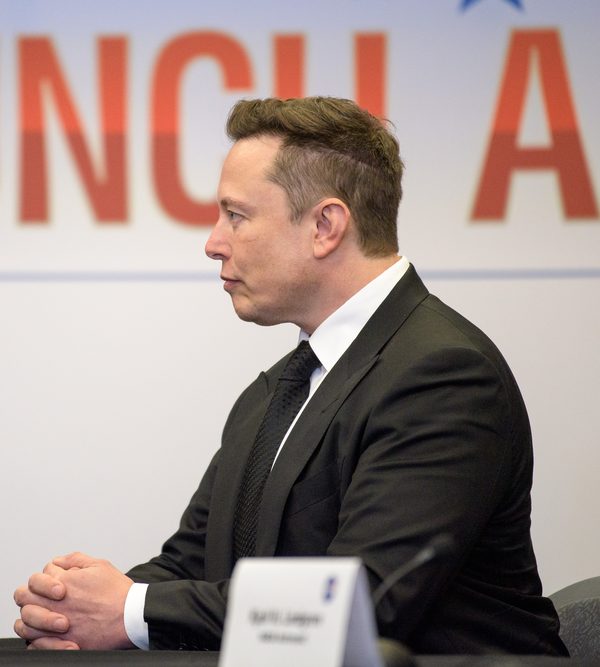
Musk founded SpaceX in 2002. Esquire reported that he started it "with $100 million of the money he made from PayPal." Its first three rockets failed. The fourth reached orbit on September 28, 2008. He said later: "We were running on fumes at that point," and that a fourth failure "would have been absolutely game over." On December 23, 2008, NASA awarded SpaceX a $1.6 billion contract to carry cargo to the International Space Station. In 2014 he told the interviewer Scott Pelley that when NASA called with the news, he blurted out: "I love you guys." Pelley said: "They saved you." Musk answered: "Yeah, they did."
The start, and public money
Musk founded SpaceX with his own money. Government contracts kept it alive in 2008 and have paid for much of its work since. It has also done things no one had done before.
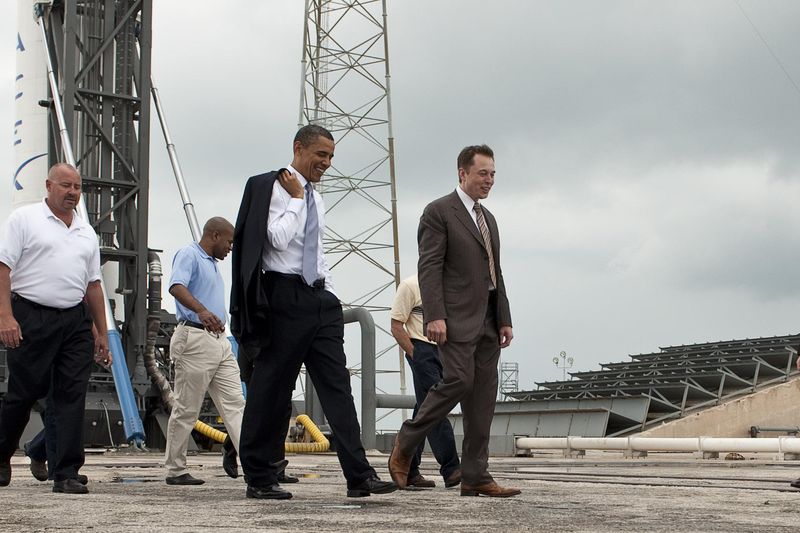
Three published counts of public money exist, and they measure different things. The Washington Post counted $38 billion in government contracts, loans, subsidies and tax credits for all of Musk's companies over about 20 years, most of it contracts to SpaceX. Reuters reported in June 2025 that SpaceX "has won $15 billion of contracts from NASA." The AP, from federal spending records, counted $6 billion in government contracts in the past five years, and noted that SpaceX's own filing said "a fifth of its revenue last year was from the federal government." Musk wrote in July 2025: "SpaceX won the NASA contracts by doing a better job for less money." In February 2026 he wrote that NASA "will only be ~5% of SpaceX revenue this year."
What SpaceX has done is part of the record. On December 21, 2015, it brought the first stage of a rocket back for a soft landing, "history's first-ever rocket landing during an orbital launch." On May 30, 2020, NASA said: "For the first time in history, NASA astronauts have launched from American soil in a commercially built and operated American crew spacecraft." NASA's contract for that work was worth up to $2.6 billion to SpaceX and up to $4.2 billion to Boeing. In 2025 SpaceX launched 165 rockets, which Space.com counted as "about 85% of the United States' total tally." Starlink, by the company's May 2026 filing, had "about 10.3 million subscribers in 164 countries, with more than 9,600 satellites deployed."
In April 2021 NASA chose SpaceX to build the lander for its return to the Moon, under a contract worth $2.89 billion. NASA's inspector general reported on March 10, 2026: "SpaceX's development of the Artemis III Starship has been delayed at least 2 years, with additional delays expected," and found that "SpaceX's lander will not be ready for a June 2027 lunar landing." The same report said NASA's fixed-price approach had controlled costs, with SpaceX's contract up 6 percent. In October 2025 the acting head of NASA said of SpaceX: "The problem is, they're behind." Musk answered that "SpaceX is moving like lightning compared to the rest of the space industry."
Status: NASA now plans a test flight in Earth orbit in 2027 and the first landing in 2028.
SpaceX won $885.5 million in a 2020 federal auction of subsidies for rural internet service. On August 10, 2022, the Federal Communications Commission rejected Starlink's application for the money, saying it had "failed to demonstrate that the providers could deliver the promised service." The commission reaffirmed the decision on December 12, 2023. Its chairwoman said: "We cannot afford to subsidize ventures that are not delivering the promised speeds or are not likely to meet program requirements." A Republican commissioner, Brendan Carr, dissented, calling the decision part of a "pattern of regulatory harassment."
Starlink and governments
Starlink gives one man's company a part in wars and in other countries' affairs. These are the documented occasions, with what each side said.

In September 2022 Ukraine asked Musk to extend Starlink coverage toward Crimea for a sea-drone attack on Russia's fleet, and he refused. His biographer Walter Isaacson first wrote that Musk had ordered coverage shut off, then corrected himself: "the Ukrainians THOUGHT coverage was enabled all the way to Crimea, but it was not," and "Musk did not enable it, because he thought, probably correctly, that would cause a major war." Musk said: "If I had agreed to their request, then SpaceX would be explicitly complicit in a major act of war and conflict escalation." A Ukrainian presidential adviser said that by refusing, Musk "allowed this fleet to fire Kalibr missiles at Ukrainian cities." The chairman of the Senate Armed Services Committee said: "Serious national security liability issues have been exposed."
On March 9, 2025, Musk wrote: "I literally challenged Putin to one on one physical combat over Ukraine and my Starlink system is the backbone of the Ukrainian army. Their entire front line would collapse if I turned it off." Poland's foreign minister, Radoslaw Sikorski, replied: "Starlinks for Ukraine are paid for by the Polish Digitization Ministry at the cost of about $50 million per year." He added that "if SpaceX proves to be an unreliable provider we will be forced to look for other suppliers." Musk answered: "Be quiet, small man. You pay a tiny fraction of the cost. And there is no substitute for Starlink." The same day Musk wrote of cutting Ukraine off: "We would never do such a thing or use it as a bargaining chip."
Reuters reported on July 25, 2025, citing three people familiar with the order, that during a Ukrainian counteroffensive in late September 2022 Musk told a senior SpaceX engineer "to cut coverage in areas including Kherson." Staff complied, the three people said, "deactivating at least a hundred Starlink terminals." Reuters wrote: "It isn't clear what prompted Musk's command, when exactly he gave it, or precisely how long the outage lasted." A SpaceX spokesperson said the reporting was "inaccurate" and did not say what in it was wrong. Musk did not respond to Reuters.
Source
Reuters
In August 2024 a justice of Brazil's Supreme Court froze Starlink's bank accounts in Brazil to collect fines owed by X, which had refused court orders and had no legal representative in the country. The court said on September 13 that it had taken "almost 11 million Brazilian reais ($1.9m) from a Starlink account" and unfrozen the accounts. Al Jazeera reported that "the decision to penalise both X and Starlink has been questioned by legal analysts since they function as separate companies." Musk called the justice an "evil dictator."
In March 2025 Musk wrote: "Starlink is not allowed to operate in South Africa because I'm not black." A spokesperson for South Africa's foreign ministry answered: "Sir, that's not true and you know it. It's got nothing to do with your skin colour. Starlink is welcome to operate in South Africa provided there's compliance with local laws." The country's communications regulator said it "has not received any application from Starlink or SpaceX." Reuters reported that Musk appeared to be objecting to rules that foreign-owned telecommunications licensees "must sell 30% of the equity in their local subsidiaries to historically disadvantaged groups."
The Washington Post reported in May 2025, from State Department cables, that U.S. embassies had pushed countries to clear the way for satellite companies, "often mentioning Starlink by name." By Reuters' account of the report, the cables indicate that the secretary of state "instructed officials to push for regulatory approvals for Musk's satellite firm," and "do not show that the Trump administration has demanded favors for Starlink in exchange for lower tariffs." ProPublica reported that the department had "intervened on behalf of Starlink in Gambia and at least four other developing nations." The State Department said: "Any patriotic American should want to see an American company's success on the global stage."
The Wall Street Journal reported on October 24, 2024, citing current and former officials in the United States, Europe and Russia, that Musk had been in regular contact with Vladimir Putin since late 2022, and that "Putin asked Musk not to activate his Starlink satellite system over Taiwan as a favor for Chinese President Xi Jinping." The Kremlin's spokesman called the report "untrue" and said the two had spoken once. The Journal also reported, the AP noted, that one person familiar with the talks said "there is no evidence the contacts between Musk and Putin represent a security problem for the U.S." NASA's administrator said the report "should be investigated."
Mars and Starship
Musk says SpaceX exists to settle Mars. These are his dates, in his words, and where the rocket built for it stands.
In September 2017 Musk said SpaceX would land two cargo ships on Mars in 2022 and send crews in 2024. "That's not a typo," he said, adding: "Though it is aspirational." In January 2020, asked whether that meant a million people on Mars by 2050, he replied: "Yes." In January 2025 he wrote: "No, we're going straight to Mars. The Moon is a distraction." On February 8, 2026, he wrote: "SpaceX has already shifted focus to building a self-growing city on the Moon, as we can potentially achieve that in less than 10 years, whereas Mars would take 20+ years." SpaceX's 2026 stock filing ties part of his pay to maintaining "a permanent human colony on Mars with at least one million inhabitants." No SpaceX craft has gone to Mars.
Starship, the rocket built for those plans and for NASA's Moon lander, has flown 14 test flights since April 2023. In 2025 three flights in a row ended in the loss of the upper stage, and the next two went as planned. On September 28, 2026, Reuters reported, Starship "reached orbit for the first time," which it called "a long-delayed feat for Starship, which Musk once predicted would be achieved in 2022." Reuters put the cost of the program at "more than $15 billion to date."
Who controls it, and its money
SpaceX became a public company in June 2026. Its filings gave the first full look at its finances and at how completely Musk controls it.
On February 2, 2026, SpaceX acquired xAI, Musk's AI company, which owned X. The AP reported that such purchases "were blasted by some SpaceX investors as bailouts because they are big money losers." On June 11 SpaceX priced the largest initial stock offering in U.S. history, raising $75 billion at a valuation of $1.77 trillion. Its filing disclosed "a net loss of $4.9 billion on $18.7 billion in revenue last year," debt of $29.1 billion, and that its AI segment "lost $2.5 billion in the first quarter and $6.4 billion in 2025." Starlink earned an operating profit. Reuters reported that "Musk will hold 82% of SpaceX's voting power after the IPO," and that "the only person who can fire Musk is Musk." Shareholders are barred from bringing class actions against the company.
Status: SpaceX reported a net profit of $4.4 billion for the three months ended September 30, 2026.
SpaceX's filing listed its dealings with Musk's other companies. Reuters reported that SpaceX and xAI "collectively bought about $650 million in goods and services from Tesla last year," including "$131 million on Tesla's stainless-steel Cybertrucks at suggested retail prices, which would buy more than 1,000 of them." It also listed lease payments by xAI to a private company Musk owns. On October 20, 2026, TechCrunch reported: "The boards of SpaceX and Tesla have each formed special committees to review a possible merger." Musk said: "Because I'm a conflicted party, I can't actually be in the discussions of the special committees."
Status: No merger terms had been announced as of November 15, 2026.
Workers
What reporters, regulators and courts have documented about injuries and the treatment of employees at SpaceX. Several cases against the company ended with no ruling either way, and the facts say so.
A Reuters investigation "documented at least 600 injuries of SpaceX workers since 2014," including "eight accidents that led to amputations," and one death. Lonnie LeBlanc died in June 2014 at the company's test site in McGregor, Texas; the federal workplace safety agency "later determined that SpaceX had failed to protect LeBlanc from a clear hazard," and a settlement "allowed SpaceX to pay a $7,000 fine." At the launch site near Brownsville, Texas, the 2022 injury rate was 4.8 per 100 workers, "six times higher than the space-industry average of 0.8." The next year it was 5.9. Reuters found that federal and California regulators had fined the company "a total of $50,836 for violations stemming from one worker's death and seven serious safety incidents." SpaceX did not respond to Reuters' questions.
A crane collapsed at SpaceX's Starbase site in Texas on June 24, 2025. The federal workplace safety agency cited SpaceX for seven "serious" violations and proposed penalties totaling $115,850. Jose Luis Bautista, 25, died at Starbase on May 15, 2026, after falling from scaffolding, a local justice of the peace said. The city of Starbase said he was believed to work for a contractor, and the safety agency said it was investigating. SpaceX did not respond to questions about his death.
Status: SpaceX is contesting the crane penalties, federal records showed in May 2026. No result of the investigation of the death had been reported as of November 15, 2026.
On January 18, 2022, part of a rocket engine broke away during a pressure test at SpaceX's site in Hawthorne, California, and struck a technician, Francisco Cabada, in the head. California's workplace safety agency "levied a fine of $18,475 for the violation that resulted in Cabada's skull fracture." SpaceX told the agency it should not be held responsible because it gives extensive safety training and the malfunction was not reasonably foreseeable. In January 2024 his wife sued SpaceX for negligence; Reuters reported then that he "remains in a coma more than two years later." SpaceX did not respond to questions about the lawsuit.
Status: The outcome of the lawsuit was not found, and nothing about his condition after January 2024 was found.
In June 2022 SpaceX employees circulated an open letter inside the company. It said: "Elon's behavior in the public sphere is a frequent source of distraction and embarrassment for us." The next day the company's president, Gwynne Shotwell, told staff that SpaceX had "terminated a number of employees involved," and wrote: "We have too much critical work to accomplish and no need for this kind of overreaching activism." In January 2024 the National Labor Relations Board issued a complaint accusing SpaceX "of unlawfully firing eight employees for circulating a letter." The next day SpaceX sued the board, arguing that its structure is unconstitutional, and courts paused the case. In January 2026 a second federal agency found that "SpaceX is subject to" the labor law that covers railroads and airlines instead. The labor board then dismissed the case, writing that it "lacks jurisdiction over the employer."
The same eight former employees sued SpaceX and Musk in California in June 2024, "alleging that Musk personally ordered their firing after they accused SpaceX of tolerating sexual harassment in the workplace." SpaceX has denied the allegations. It asked the courts to send the case to private arbitration. On November 10, 2026, a federal appeals court ruled, two judges to one, that the case can continue in court.
Status: The case is pending. SpaceX can ask for further review of the ruling. Every claim in it is an allegation.
In August 2023 the Justice Department filed a complaint alleging that SpaceX had discouraged refugees and people granted asylum from applying for jobs and had "falsely claimed it could not hire non-U.S. citizens because of export control laws." Musk called it "yet another case of weaponization of the DOJ for political purposes." SpaceX denied wrongdoing and sued, and in November 2023 a federal judge blocked the department's case from going forward. In February 2025, a month after Musk joined the Trump administration, the department moved to dismiss its own case for good.
Launches and the aviation regulator
The Federal Aviation Administration licenses SpaceX's launches. Starship is a test program, and SpaceX says failures are how it learns. These are the times the agency or others documented effects beyond the launch site.
The first full Starship lifted off from Boca Chica, Texas, on April 20, 2023, and blew up in flight. The launch also wrecked its own pad, throwing chunks of concrete in several directions. The next day Musk wrote: "we wrongly thought, based on static fire data, that Fondag would make it through 1 launch." Fondag is the concrete under the pad. The Federal Aviation Administration grounded the rocket and on September 8, 2023, closed its investigation. "The final report cites multiple root causes of the April 20, 2023, mishap and 63 corrective actions SpaceX must take to prevent mishap reoccurrence," it said.
On September 17, 2024, the Federal Aviation Administration proposed $633,009 in penalties against SpaceX "for allegedly failing to follow its license requirements during two launches in 2023." Musk answered: "SpaceX will be filing suit against the FAA for regulatory overreach." SpaceX wrote to Congress denying that it had broken its licenses. Eight days later Musk posted that the agency's administrator, Michael Whitaker, "needs to resign." Whitaker announced in December that he would resign and did so on January 20, 2025, the day of Trump's inauguration, 15 months into a five-year term.
Status: No report was found that the penalties were paid, reduced or withdrawn, or that SpaceX filed the lawsuit.
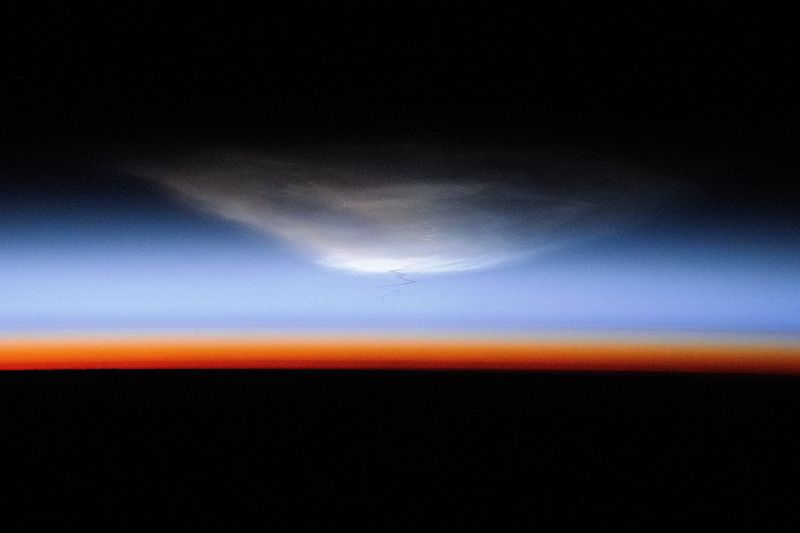
Starship broke apart over the Caribbean on January 16 and March 6, 2025. In January the aviation agency set up a debris area that forced planes to reroute, and the Turks and Caicos Islands grounded and diverted flights; officials there looked into reports of property damage. No injuries were reported. Musk captioned a video of the falling debris: "Entertainment is guaranteed!" SpaceX said surviving debris "would have fallen into the designated hazard area." ProPublica later reported: "There were at least 11 planes in the closed airspace when Starship exploded." None was damaged. The agency told ProPublica that it "limits the number of aircraft exposed to the hazards, making the likelihood of a catastrophic event extremely improbable." After another Starship flight on May 22, 2026, the agency again declared a mishap and required an investigation.
On February 19, 2025, the upper stage of a SpaceX Falcon 9 fell to Earth uncontrolled over Europe, and the Polish Space Agency confirmed that debris from it was found in western Poland. SpaceX said a liquid oxygen leak had prevented the engine burn that would have brought the stage down over the ocean, and that it was working with Poland on the cleanup. The month before, Qantas said it had delayed several flights between Johannesburg and Sydney on advice from the U.S. government about SpaceX rocket stages reentering over the Indian Ocean, adding that "the timing of recent launches have moved around at late notice."
The Texas launch site
SpaceX builds and launches Starship at Boca Chica, on the Texas coast beside a wildlife refuge and a public beach. Regulators have penalized it once there, and courts have ruled for SpaceX's side in the main lawsuits.
After the 2023 launch, SpaceX built a system that floods the pad with water at liftoff. The Environmental Protection Agency alleged that SpaceX "did not have" the required permit and "was not authorized to discharge pollutants from the facility to waters of the United States." In 2024 SpaceX agreed to a federal penalty of $148,378, neither admitting nor denying the allegations, and Texas's environmental agency fined it $3,750. Musk wrote: "Just to be clear, this silly fine was for spilling potable drinking water!" SpaceX said it had asked both agencies whether it needed to stop using the system "and we were informed that operations could continue."
The New York Times reported in July 2024 that when Musk first looked at South Texas, "he promised that SpaceX would have a small, eco-friendly footprint and that the surrounding area would be 'left untouched.'" It found that "On at least 19 occasions since 2019, SpaceX tests of Starship rockets or prototypes caused fires, leaks, explosions or other problems." NPR reported that a launch the month before "destroyed nests of a vulnerable population of shorebirds." SpaceX executives declined the Times's requests for comment. Musk replied to the front-page story: "To make up for this heinous crime, I will refrain from having omelette for a week."
The main lawsuits over the Texas site have gone SpaceX's way. In September 2025 a federal judge dismissed a suit by environmental groups and the Carrizo/Comecrudo Tribe of Texas that challenged the aviation agency's environmental review, writing: "Most of the (assessment's) conclusions were well-reasoned and supported by the record." On June 19, 2026, the Texas Supreme Court ruled that environmental groups had no right to sue over the closing of Boca Chica Beach during launches. In California, the state's Coastal Commission apologized to Musk in April 2026 and settled a suit in which SpaceX said commissioners had voted against its launches because of his politics; the commission "acknowledged its members made 'improper' statements about Musk's political beliefs."
On May 3, 2025, residents of the area around the launch site, most of them tied to the company, voted 212 to 6 to make it a city called Starbase. The next month the Texas Legislature gave the new city the authority to close the public beach for launches, "giving more power to municipal officials with close ties to SpaceX over the objections of local activists." In 2026 the federal government moved to give SpaceX land from a national wildlife refuge in exchange for land elsewhere, and a federal court "denied a request for a preliminary injunction from conservation groups and a Native American tribe seeking to block the exchange," which "involves more than 700 acres of federally protected land."
Status: The lawsuit over the land exchange continues.